The Futility of Dark Souls
🧑 Hidetaka Miyazaki ☠ Dark Souls ⚔ Infinite Blades

Hello! We hit 50+ subscribers! Appreciate the support :)
We didn’t post last week because today’s piece is special for us (and a long one :P). We have culminated some of our learnings from the research we have done so far for Infinite Blades. This is not a sponsored post. This one’s straight from our heart! ❣
Before we dive in, some housekeeping:
Please move this post from the ‘Promotions’ tab to the ‘Primary’ tab in your email client. It helps :D
Today’s gonna be a long one, grab some 🍿 and have fun!
If you have any feedback or suggestions to share by the end of this post, feel free to DM us on Twitter.
In today’s article, we’ll unravel the world of Dark Souls and talk about how it impacts Infinite Blades and here are some of the things we’ll cover:
The futility of games
The origins of Hidetaka Miyazaki
Exploring the world of Dark Souls
Level Design in Dark Souls
Our key takeaways
What this means for Infinite Blades
Without further ado, let’s dive straight into it!

Recently, Naval shed light on what he thinks is the purpose of games.

We pondered upon this for a while. It initially didn't make sense to us. What does Naval mean when he says that games are a waste of time? We're both trying to build our careers in game design, so it was difficult to wrap our heads around this. Gradually, the fog of doubt cleared up and we realized that we agreed with the tweet.
The Futility of Games
It is very easy to forget the fact that games are a form of art and expression because of their intimate relationship with software and technology. Jesper Juul, a game researcher, states in one of his essays, The Art of Failure, that games are essentially an art form that creates an aesthetic out of suffering. Our interpretation of this is that any game's primary goal is to provide entertainment at the cost of the player's time and effort. As a result, the player is faced with a predicament that forces them to reflect on whether the struggle is really worth it to them. The best game designers intrinsically understand this, and always keep it in mind when making decisions.
In fact, we think that Dark Souls, the game that inspired us to work on Infinite Blades, exemplifies this! Dark Souls is a hack-and-slash action role-playing game that is set in a medieval era. It has been considered by many to be one of the best video games of all time! Dark Souls, along with the rest of its Soulsborne counterparts, places a heavy emphasis on the futility and absurdity of the hero's journey. Here's a quote from H.P Lovecraft that demonstrates the massive influence the writer's work (along with other literary masterpieces that fall in the cosmic horror genre) has had on From Software's games.
The most merciful thing in the world is the inability of the human mind to correlate all its content.
These influences have led to intriguing design decisions in From Software's games. For instance, take Demon's Souls, the predecessor to Dark Souls. It is responsible for allowing Hidetaka Miyazaki, the mastermind behind the Souls series, to experiment with the insane ideas he had at that time. These ideas weren't widely appreciated upon the initial release (largely due to the difficulty settings), but the seeds of innovation bore fruit upon the release of Dark Souls a few years later. Usually, in an ARPG, a tutorial boss is created to drill the game's mechanics into your head. But, in Demon's Souls, the tutorial boss exists for the sole purpose of one-shotting you! From Software's games focus a lot on player agency, but they also go out of their way and show that you are insignificant in the world's flow of events. Here's a funny video (timestamped) of Pewdiepie going against the tutorial boss in the remastered version of Demon's Souls.
In the world of Dark Souls, the narrative functions as parts of a puzzle that are scattered all across the world. Due to the difficulty and vastness of the game, it is improbable that you'd have pieced it all together by the end of your journey. The stench of decay brought forth by sentient beings that exist in this world is evident in Dark Souls and right from the outset, the player is informed that their pursuit for truth will inevitably lead to their insanity. Surprisingly, this is by design and the player is supposed to feel disoriented by the disparate themes that are set in motion.
Now, before we dive further into the world of Dark Souls and attempt to explore what makes it so unique, let's do a quick detour to learn about the life of Hidetaka Miyazaki, the game’s director & From Software's meteoric rise from a software provider to a pioneer in the RPGs genre.
The Origins of Hidetaka Miyazaki
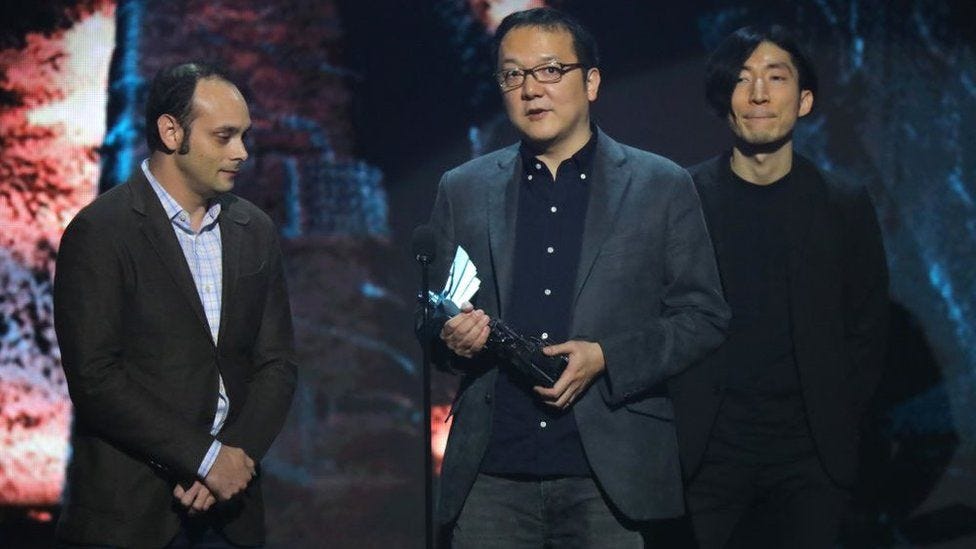
It is extremely difficult to extract information about Miyazaki's life because of his elusiveness from the media. Fortunately, we stumbled upon a few excellent video essays and interviews that gave us valuable insights into his game design philosophy.
Childhood & Inspirations
As a kid, Miyazaki grew up poor, but his humble origins did not hinder his ardent love for books. Unfortunately, Miyazaki didn't have access to books that catered to his reading level. So, he read whatever he could get his hands on. Miyazaki constantly felt that he was out of his depths, but made up for it by letting his imagination run wild. Miyazaki said that this peculiar behavior of his made him feel like he was co-writing the pieces of fiction along with the writers. Eventually, this led to young Miyazaki devouring shelves of books. And the ones that had the most lasting impact on Miyazaki had underlying themes of Lovecraftian horror and philosophy; the most notable one being Berserk, a manga written by Kentaro Miura.
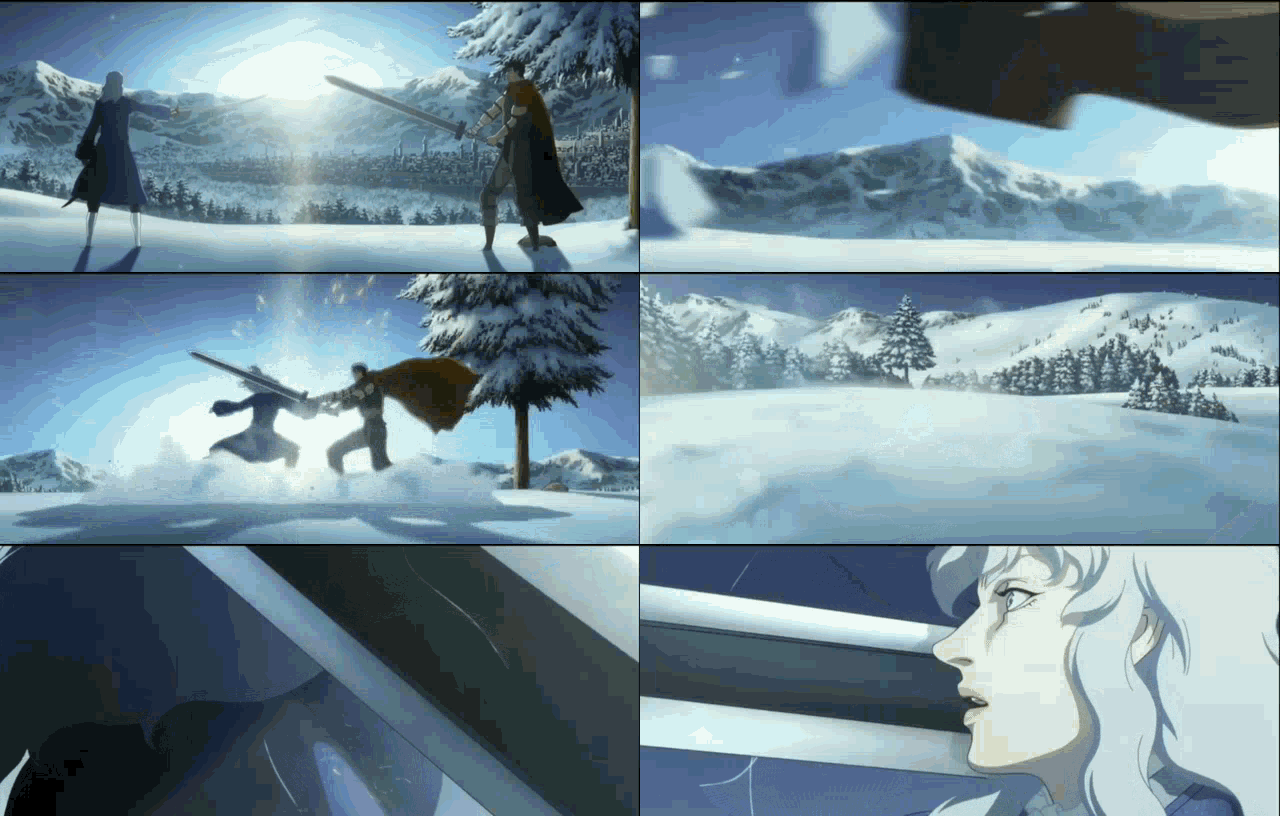
On a side note, if you consider yourself to be a weeb, you should definitely check out Berserk. It's a masterpiece and it's interesting to see the influence it had on Miyazaki's work.
Astonishingly, Miyazaki had never touched a game until his late teens, but he has publicly voiced his love for The Legend of Zelda and Ico particularly because of their innovative level design and ambiguous style of storytelling respectively.
The Big Break
Another lesser-known fact about Miyazaki is that the first project he played an integral role in was not Dark Souls, but rather its predecessor, Demon's Souls.
From Software had deemed Demon's Souls to be a failure halfway through its development and Miyazaki immediately pounced on the opportunity because he felt that this would allow him to develop a project without having to bear the repercussions of failure. Win-win right? Demon's Souls was not nearly as successful as Dark Souls, but it was the first project that gave Miyazaki the creative freedom to bring all of his wild ideas to life.
Transient Beings and Shared Experiences
Once, Miyazaki was involved in a terrible road accident that could have led to his untimely demise. This incident has had a lasting impact on him and it also triggered the development of the most non-essential yet badass features of Dark Souls! Stick with us till the end to learn more about that.
On an ordinary snowy day, while Miyazaki was driving his car uphill, his car ground to a halt, and as a result, so did all of the other cars that were trailing behind him. Fortunately, the car at the tail end of the trail continued pushing forward, and because of the acceleration, all of the cars were able to overcome the situation. Although everybody came out of the plight unscathed, no one had the time to stop and thank their savior. This made Miyazaki wonder, what would happen if somewhere down the line, everybody who was involved met up together? Would they be able to laugh cheerily and joke about their good fortune? Or would they bicker and fight amongst themselves? Miyazaki was fascinated by the thought that transient beings could greatly influence one another's experiences.
Creating A World that Suit the Mechanics
Miyazaki has an uncanny approach to designing games. He prioritizes building the core mechanics of the game before proceeding to create a world that caters to the mechanics. From Software's games constantly ensure that their worlds enable the players to grasp meaning and purpose for themselves. They do this by wittily making use of ambiguous storytelling methods to emphasize the vastness of the world. You're encouraged to explore the environments and remember obscure dialogues with NPCs so that you can form an interpretation of the story. As a result, you end up with completely different takeaways from your friends!
This counter-intuitive approach to designing games makes it nearly impossible to create an exact replica of Dark Souls that is set in another world. Here's a quote from Miyazaki in an interview that aptly sums up the reasoning behind this:
I think my philosophy towards game development is first, set a certain game system, and then apply a worldview that matches that. When it comes to Souls, first of all, I came up with the action RPG game system, and then applied the mythology. I might come up with, for instance, a simulation or strategy system, and then if the Dark Souls worldview worked with that system, there could be a chance the universe might expand into that gaming genre. But the other way around doesn't work for me -- I couldn't start from a worldview, like Souls, and then make another type of game fit that mold.
This tendency is reflected in every one of From Software's releases.
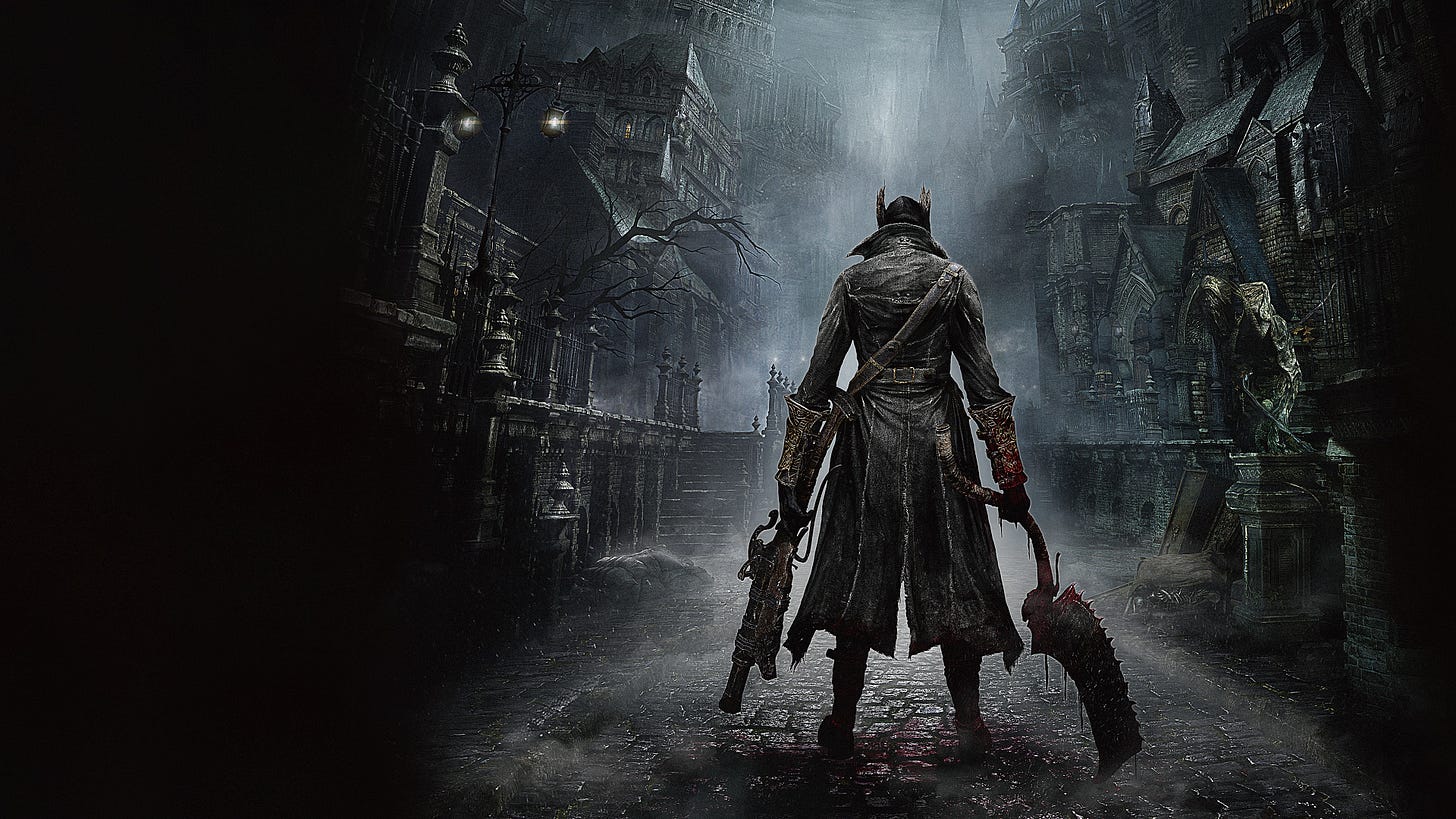
Bloodborne's fast-paced and aggressive combat aims to display the frenzy of the hunt for plague-inflicted inhabitants in the town named Yharnam. Bloodborne wants you to defeat these monsters and unravel the truth.
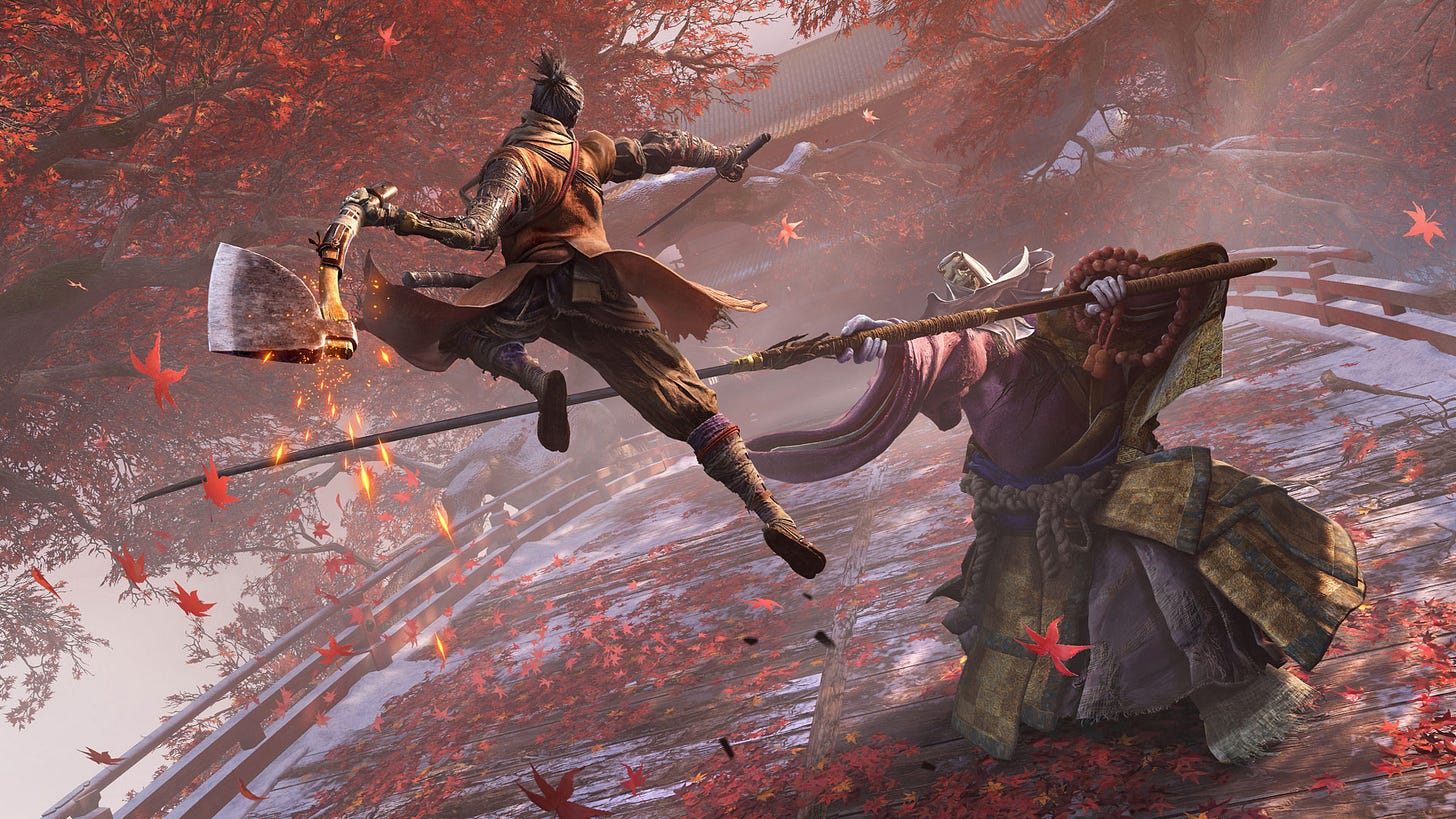
In Sekiro, we explore what makes one a shinobi. And this is displayed through the graceful combat that enforces a perfect balance between offense and defense. In this game, there isn't a concept of character builds, but the player agency still exists by enabling verticality (with the help of the grappling hook) in a linear world.
Exploring the World of Dark Souls
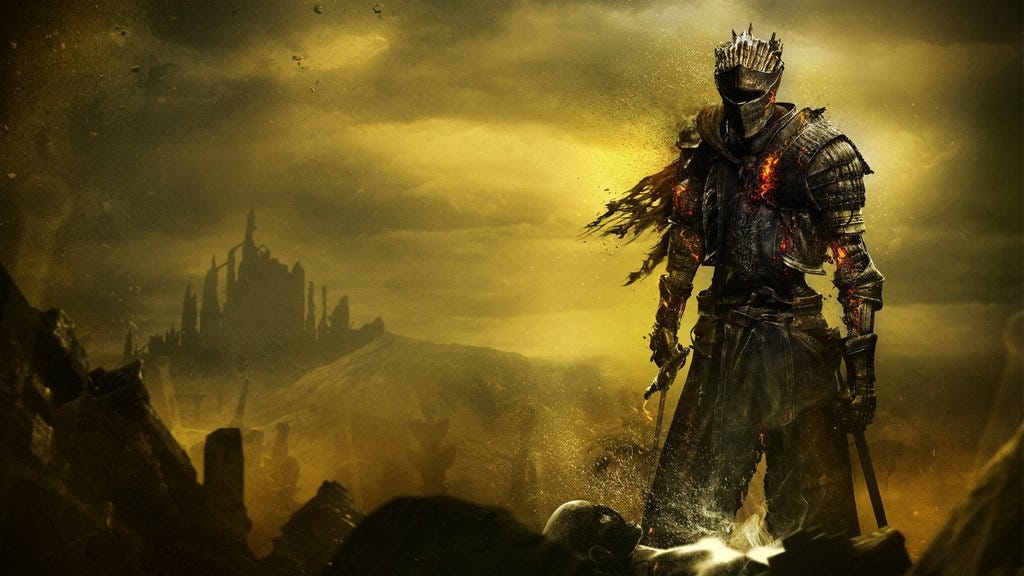
Now, let's get to the meat of things! We're finally going to talk about what we've learned from the story and mechanics of Dark Souls. We're not going to go in-depth by being too technical because we aim to provide you with a concise overview that could hopefully draw you into the amazing world of the game.
The Age of Dark
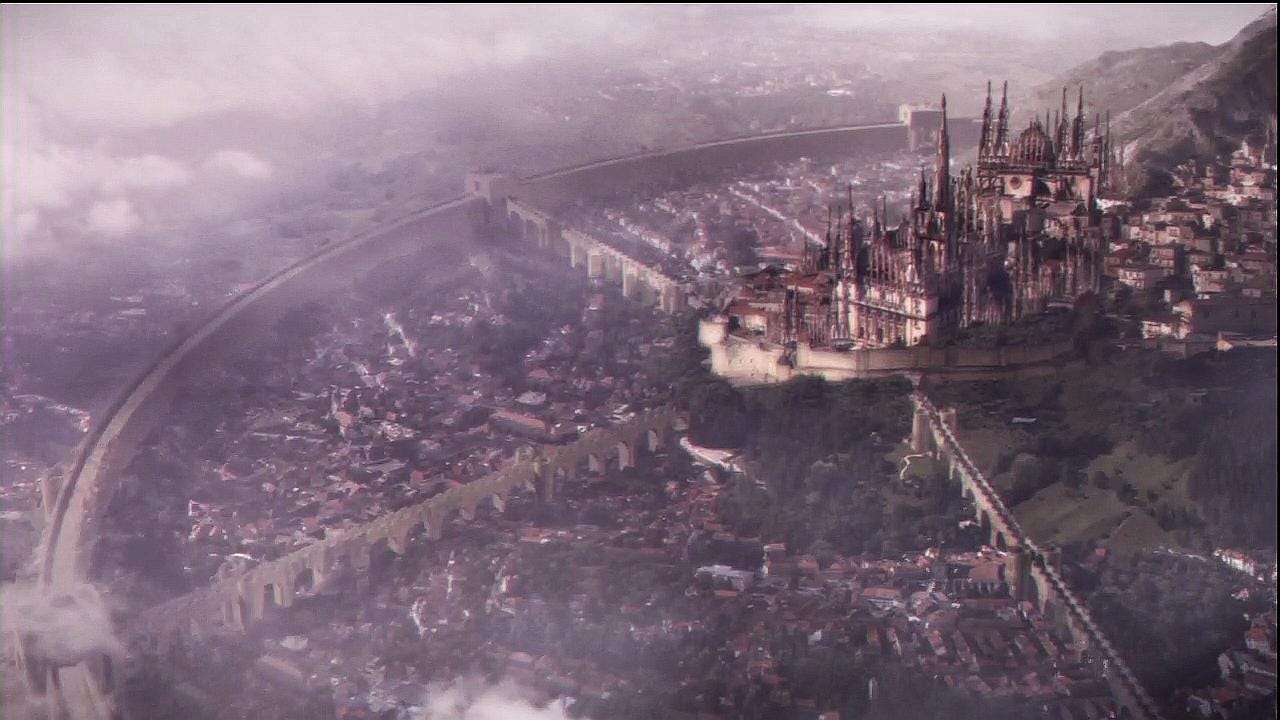
Dark Souls is set in a world where the Age of Fire is drawing to a close and the new Age of Dark is being ushered in. You're a chosen undead, i.e., a human who has been cursed with the Dark Sign. This curse gifts you with the power to never truly die unless you give up. But, this power comes at the expense of your sanity. As you journey across the world of Dark Souls to ring the 2 Bells of Awakening, you're presented with the choice to either end the Age of Fire or become the flagbearer for the Age of Dark.
Souls and Bonfires
In Dark Souls, bonfires serve as a checkpoint for players to rest and save their progress in the game. So, in the event of your death, you will be respawned at the last bonfire you rested at. Every time you rest at a bonfire, enemies that were previously slain are revived while you recover from damages to your Health and Stamina.
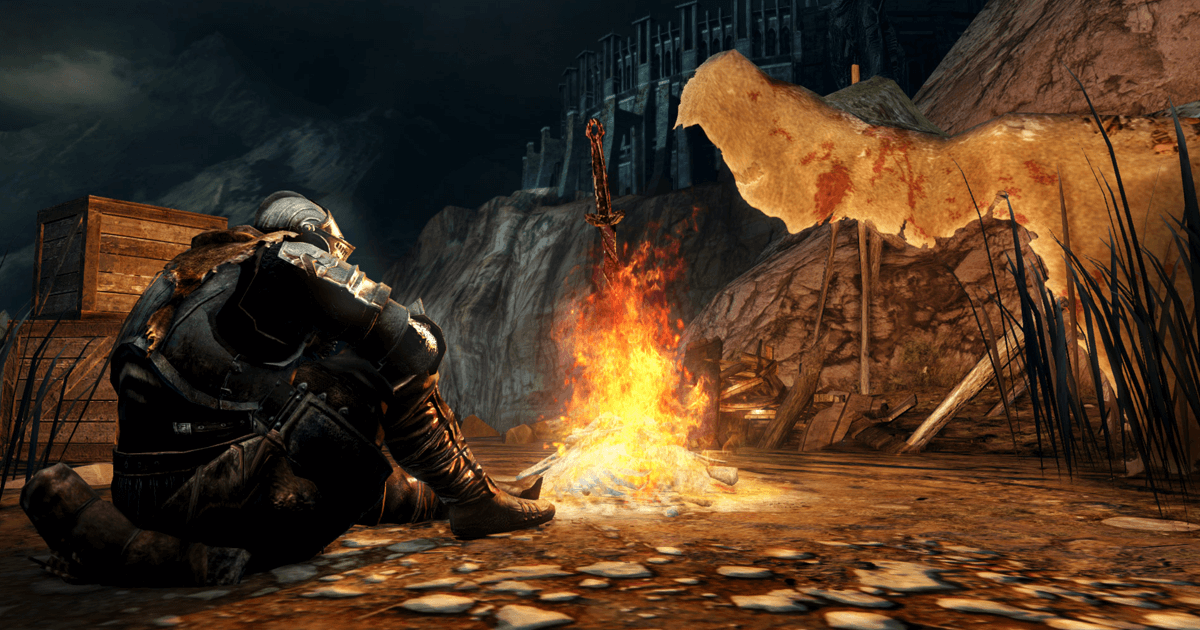
You can also use the souls you've accumulated throughout the game either from rewards in quests or conquered enemies to level up your character stats or fix your blades since they dull upon being used often and deal lesser damage.
Death
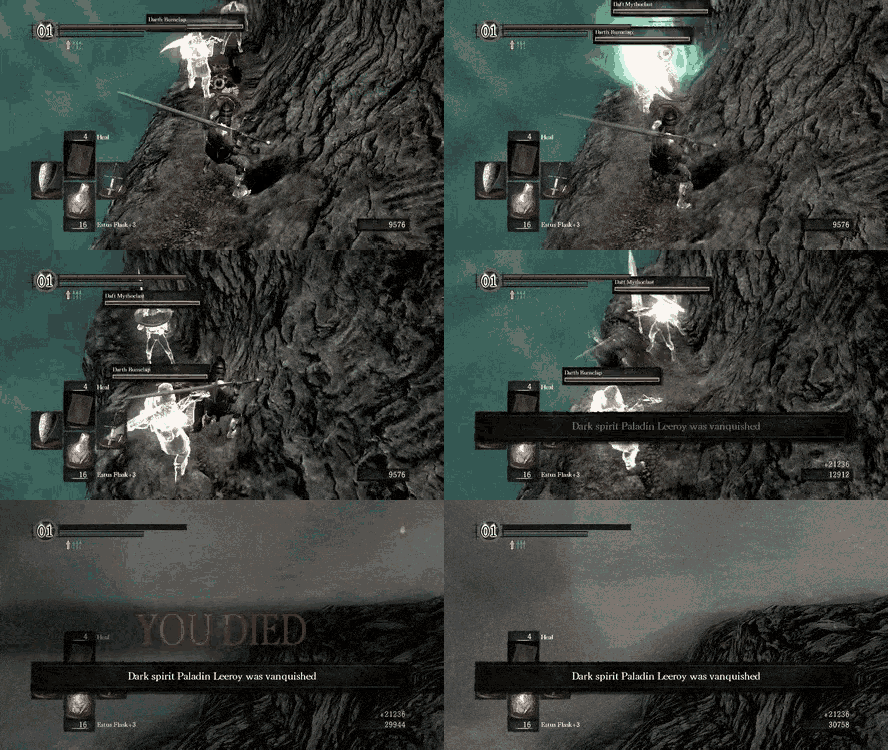
Death is an event that has severe consequences in the world of Dark Souls. Every time you die, you're respawned at the last bonfire that you've rested at. The souls and equipment items that you were carrying are dropped at the location of your death. Although you can retrieve these items by going back, dying a second time leads to dire consequences because the loot is lost forever!
The Chosen Undead and Humanity
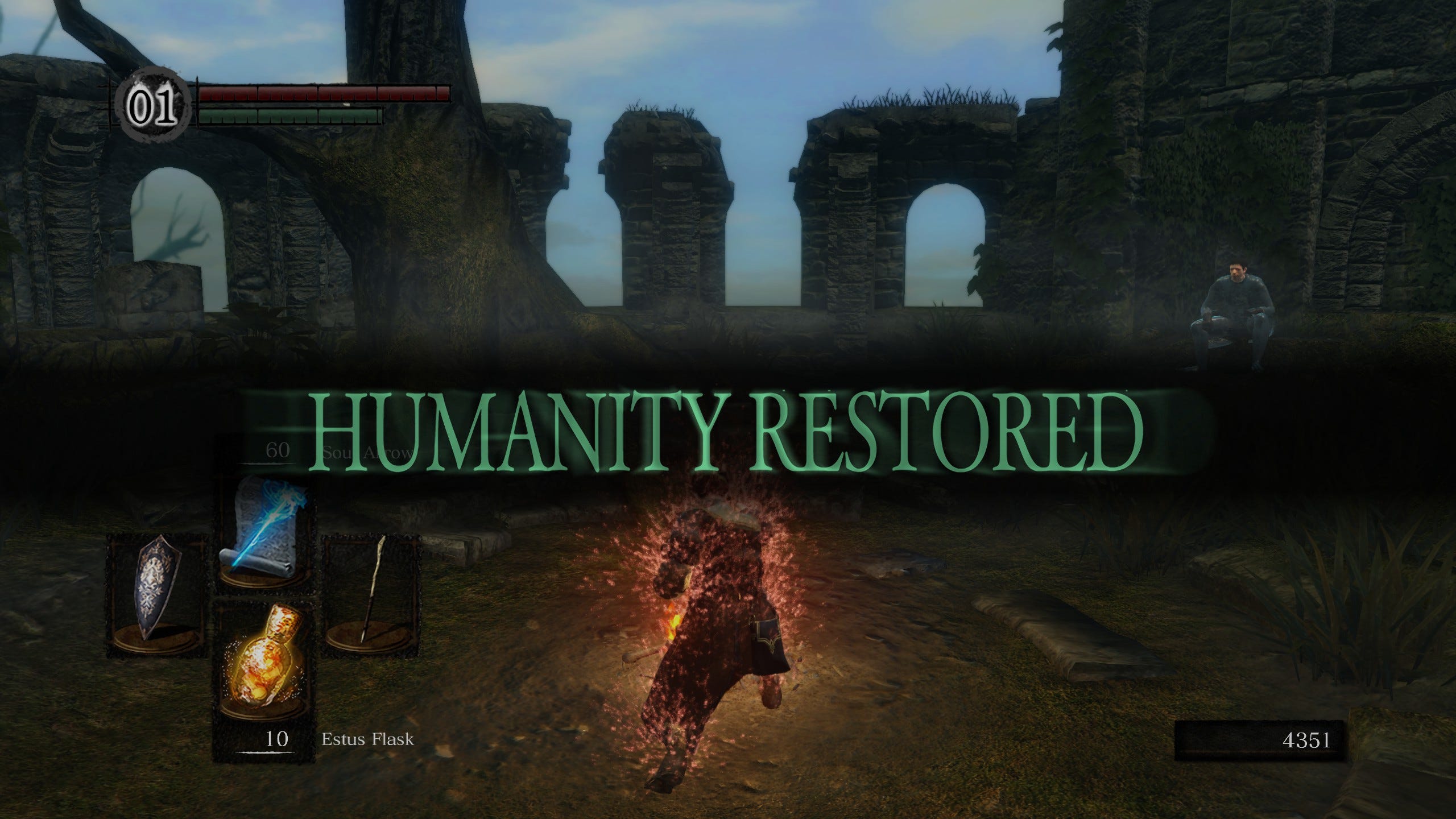
As an undead who's on the verge of insanity, you've been chosen to save the world from peril. You're clinging on to the last of your humanity and when you progress in the game, you can reverse the gradual decay of your physical form, aka hollowing, by offering the humanity you've obtained at bonfires. This humanity is an in-game item that you can collect and it shows up beside your healthbar. When you regain your human form, you are gifted with a substantial increase in health. But the flipside to this is that you are now prone to invasions. More on this in the PvP section!
Combat
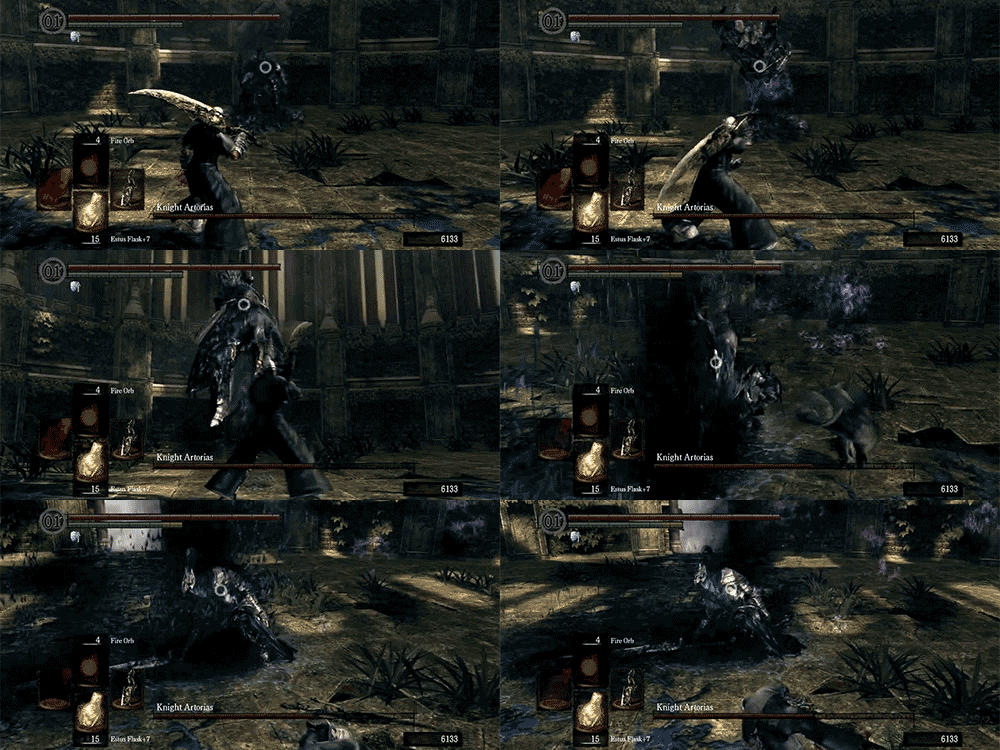
Dark Souls has a relentlessly exacting combat system that forces you to commit to every action that you perform, i.e. a roll, parry (counter move), block, backstab, etc. Each and every one of these actions consumes chunks of your stamina that regenerates over time. Thus, the interplay of these elements constantly forces the player to be thoughtful about their course of action.
Weapons
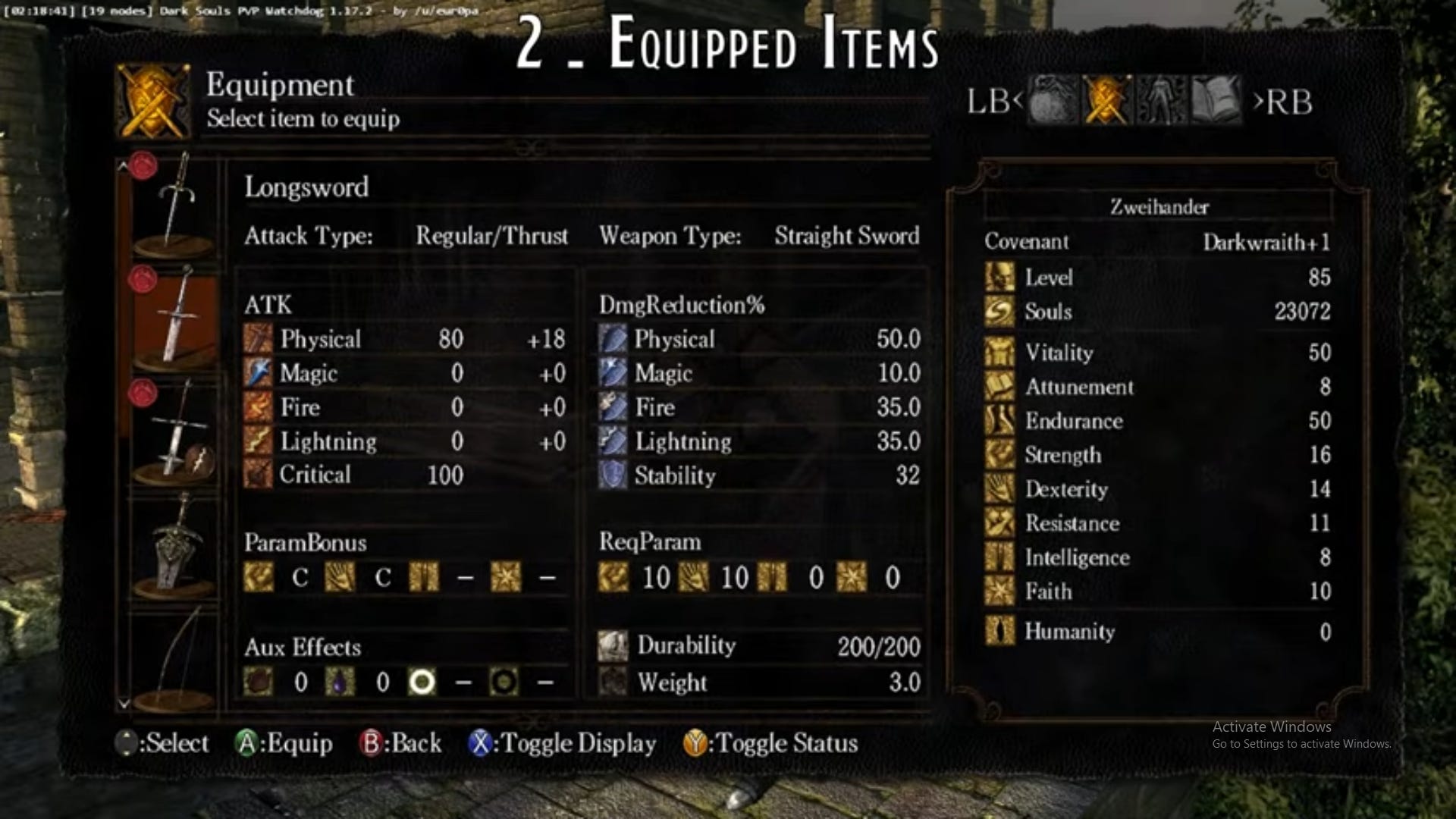
Broadly speaking, weapons can be categorized into 3 physical damage dealing types: Thrust, Slash, and Strike. We also have additional damage types that can be caused by elements such as Magic, Fire, and Lightning.
Weapons also have a special property known as Scaling Parameters. This means that the damage dealt by the weapon increases as the stats of the player such as Strength, Dexterity, Intelligence, and Faith increase. This allows players to create unique character builds, which in turn leads to unique combat styles.
Stylistic matchups are what make combat interesting. This applies to sports such as football, tennis, and even physical combat sports such as MMA. Now, imagine a grappler who's going up against a striker.
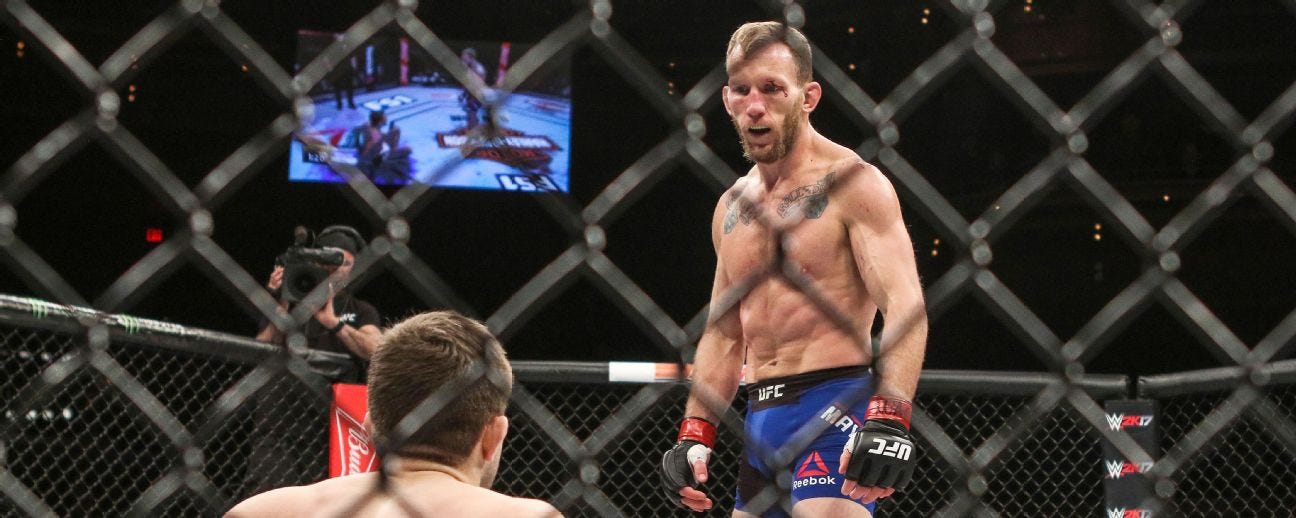
These are 2 diverse forms of combat and a clash between them forces both of the combatants to come up with creative strategies.
Similarly, in Dark Souls, imagine somebody with a Caster build, i.e. a character that is skilled at casting magic spells being pitted against somebody with a Strength build who prioritizes using Great Swords to crush their enemies. The Caster is constantly trying to create space for themselves so that they can cast spells effectively while the Great Sword wielder is trying to close the gap and finish their enemy in one fell swoop. This battle to maintain the ideal range will lead to both the combatants looking for tendencies in the other person's strategy that they can exploit.
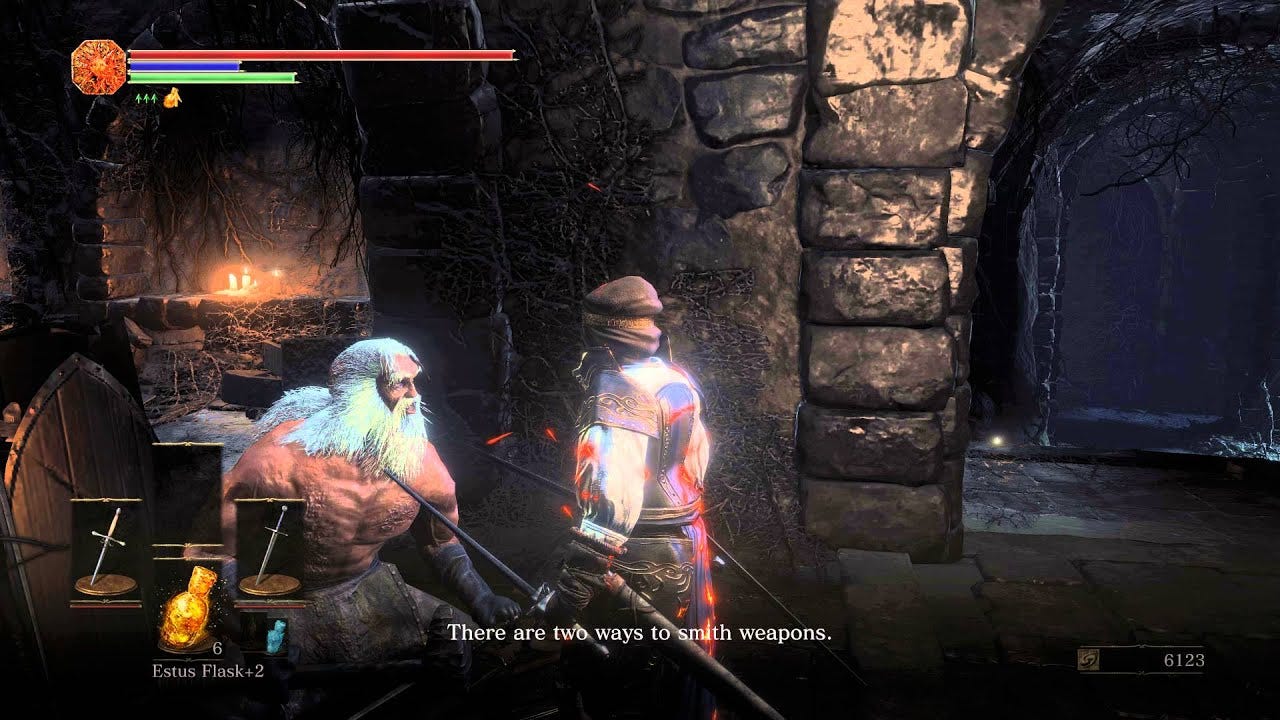
You can also upgrade your weapons with the help of a blacksmith so that weapon scaling is more favorable towards you. Your weapons can get dulled as you continue to use them in battle and a dulled weapon implies poor damage. So, you’ll need to get it fixed at a blacksmith immediately!
Character Stats
This section contains all of the accumulated information about your character such as Strength, Dexterity, Intelligence, Equipment Load, etc. Most of these stats are tied closely with the combat of the game and determine the fighting style that you're most compatible with. They can affect the kinds of weapons you're allowed to wield. For more information about this, you can check out the Dark Souls Wiki! In this article, we'd like to share our thoughts about the stat that we found most fascinating - Equipment Load.
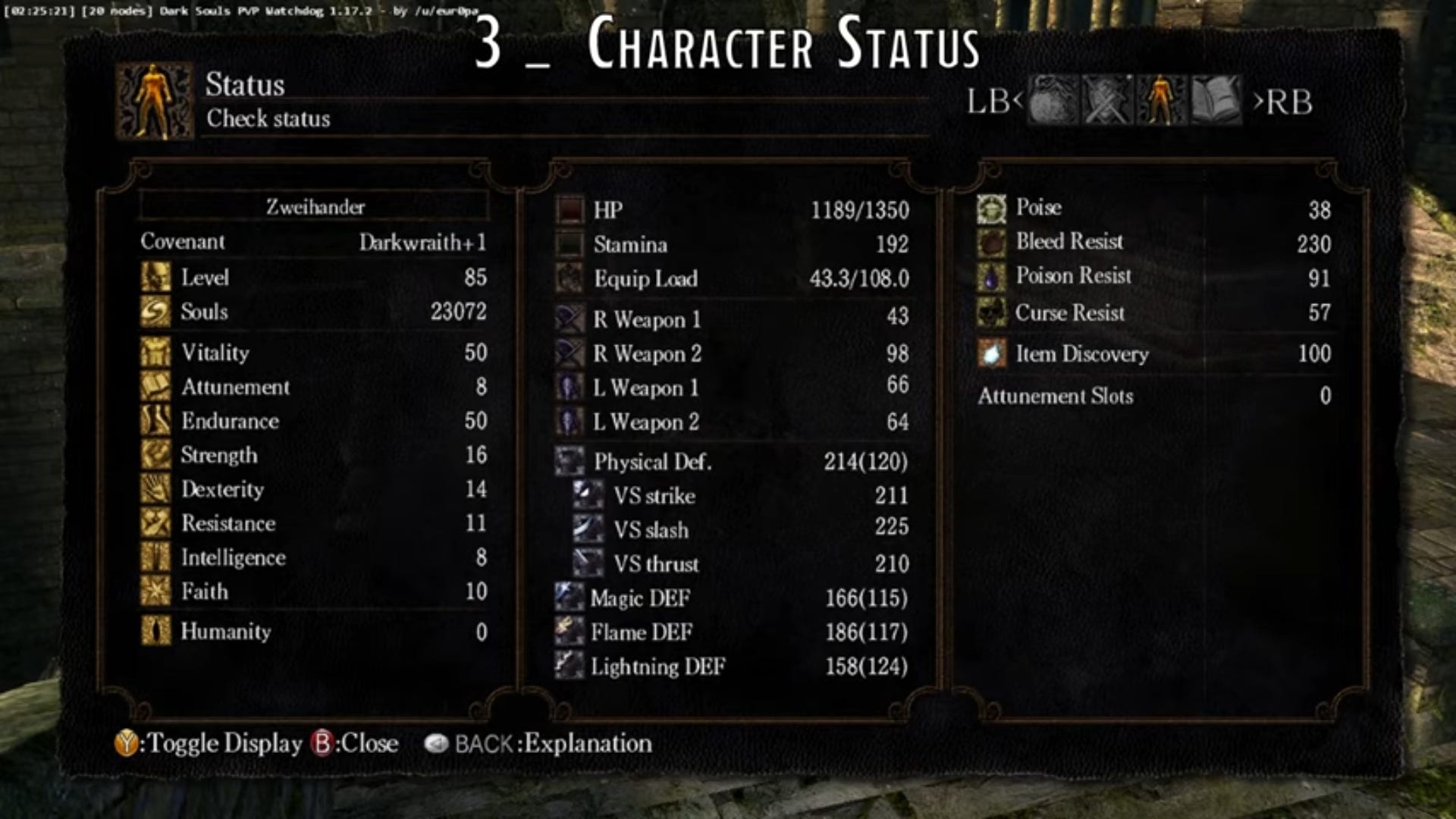
In Dark Souls, you play as a knight. And a knight never goes to war without their armor. Although this armor protects you from bleeding due to attacks, it also slows you down due to its weight. So, the value of the Equipment Load stat indicates the max cap on the equipment weight, and if the weight of the weapons and armor you have on your body exceeds this, you'll notice a significant drop in your combat abilities. Ex. slow speed, inability to roll to avoid damage, etc.
Movesets
In Dark Souls, every weapon has two combos: a Light Attack Combo and a Heavy Attack Combo. You can also chain these attacks to form unique combos that vary based on the state you were in before attacking, i.e. rolling, sprinting, etc.
Dark Souls rewards skill and timing by providing you with special moves such as a riposte and backstabs. If you block an attack right in its impact phase, you are allowed to finish your enemy with a riposte that also makes you invulnerable to incoming attacks from other enemies during the length of the animation.
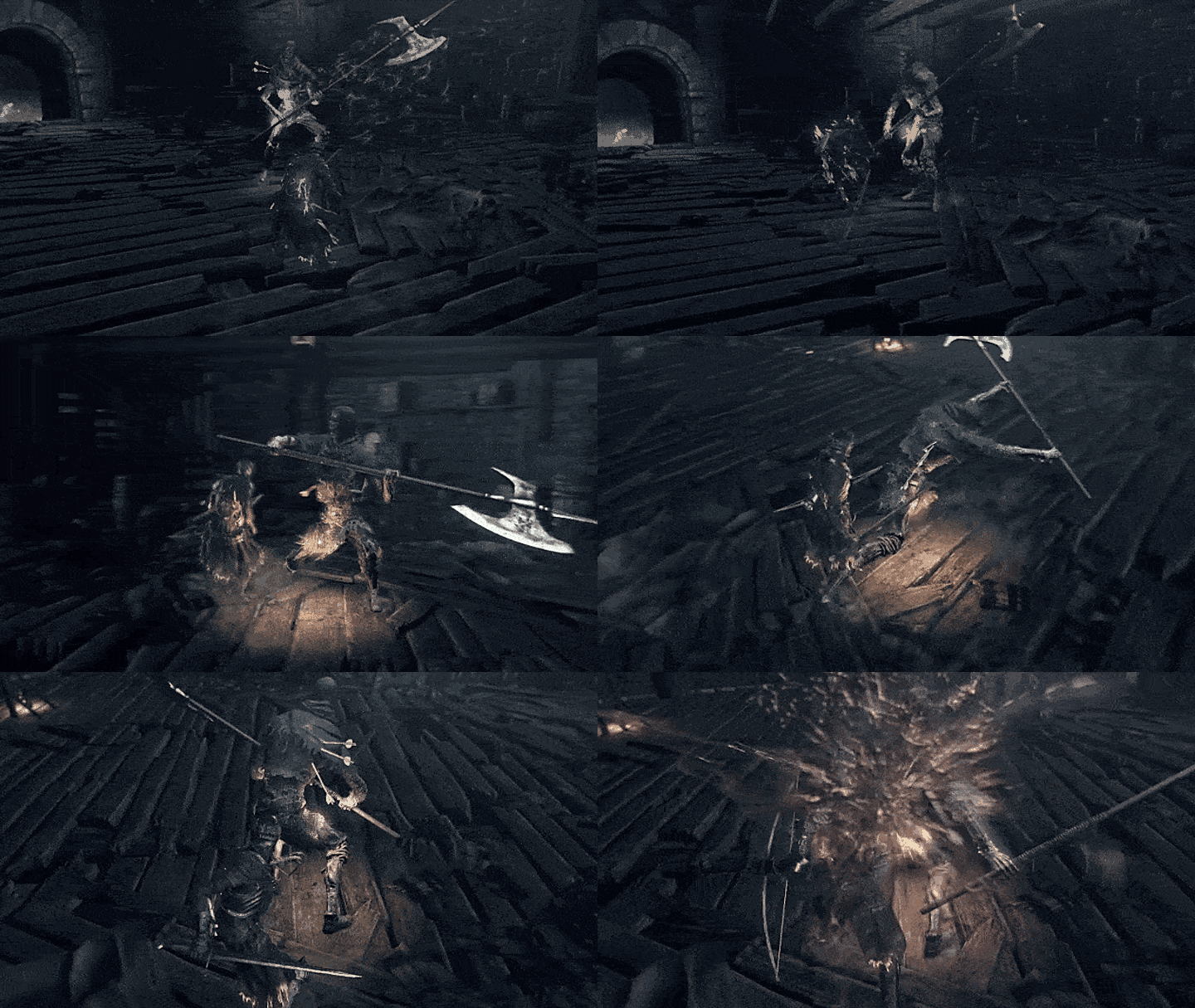
The game provides you with another finishing move that is riskier, called the backstab. In any combat sport, having your back facing the enemy can prove to be lethal, and it's the same for Dark Souls. So, if you successfully move behind your enemy, you're allowed to do a backstab. But beware, this powerful move comes with its own set of tradeoffs! While performing a backstab, your back is wide open (ironically). As a result, you're prone to attacks from other enemies and you're not allowed to evade until you complete the entire animation.
Poison and Curses
Certain enemies have the capacity to either poison or curse you. As a player, you have a poison bar which upon getting filled, leads to your unavoidable death. You can also end up getting cursed by monsters like Basilisks, which results in losing half of your HP forever. But, fret not! You can undo this by getting a special item called a Purging Stone from a specific merchant NPC.
Killing NPCs
Another cool thing about Dark Souls is that you're allowed to kill NPCs who actually provide you with valuable stuff throughout the game. These NPCs are extremely difficult to defeat, but if you do succeed, you get some goodies. However, keep in mind that if you do beat them, these NPCs are gone forever along with the quest lines and special items they had to offer.
Level Design
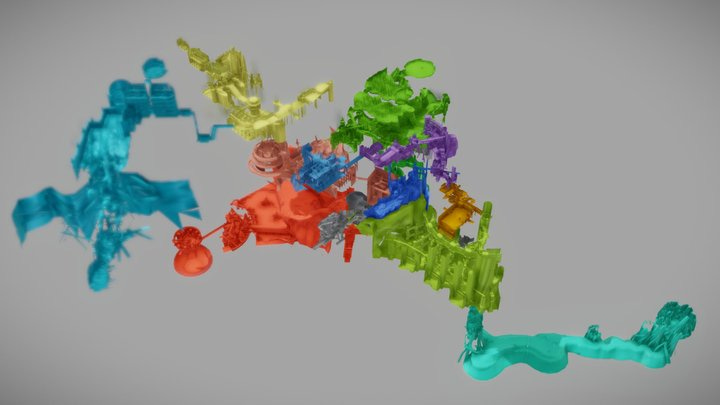
Dark Souls has an interconnected world that loops back onto itself with the help of elevators and a network of underground shortcuts. The two core elements of Dark Soul's level design are:
the ability to make combat challenging → An ideal combat situation in Dark Souls is when you can take your time to make a slow and calibrated decision before charging in and one-one combat. However, Dark Souls rarely allows this, and this is what makes the game so challenging!
non-linearity that allows complete exploration → This feature is what fascinated us the most about Dark Soul's level design and we'll be dedicating most of this section towards it.
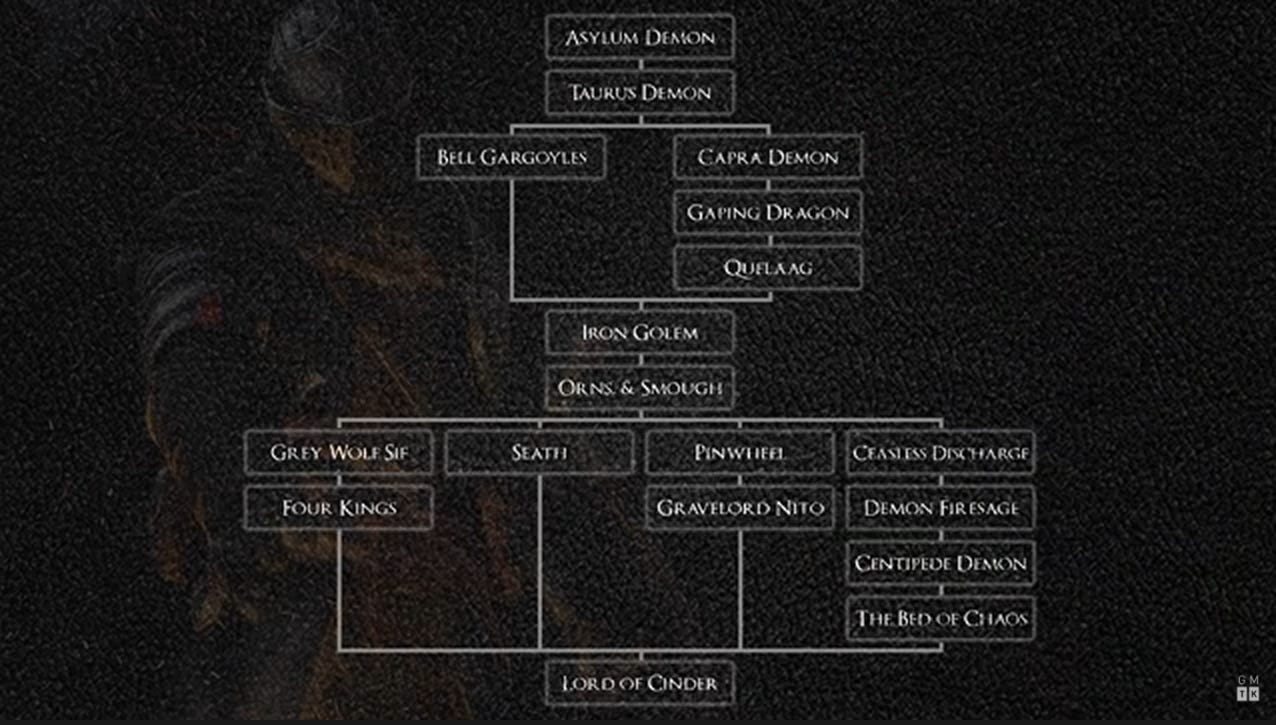
At first glance, the game can be divided into 5 Acts that are structured like an accordion. Acts 1, 3, and 5 follow a linear progression, whereas Acts 2 and 4 provide the player with multiple paths to go down in no specific order. If you've played The Legend of Zelda, this should sound familiar, because that's exactly where the developers of the game drew inspiration from! But, the developers don't expect you to play the game exactly like this. This is simply the least chaotic route to take because it manages difficulty curves satisfactorily and allows you to experience a cohesive narrative. But, in reality, you can approach the game in any way that you want. Just make sure that you're prepared to die a million times XD
Initially, this abundance of choices can seem overwhelming, so the game cordons off certain areas by locking gates and ensuring that they can only be opened from one side. Unlike other Souls games, you are mostly required to traverse across the world instead of warping from one bonfire to the next. And since you're not provided with a map, this has to be done purely off of memory! There'll be plenty of times where you stumble upon regions that you're not supposed to be exploring at your current level. Despite this, traversal gradually becomes a fulfilling activity once you're able to kill enemies that you had troubles with for hours on end in a single blow. These examples shed light on how much of a colossal task creating a non-linear world proved for the developers. They had to constantly grapple with managing the difficulty curves, which became so messy because of their creative and ambitious level design ideas.
This kind of a level design has its own flaws, but it plays to the strengths of Miyazaki's style of storytelling. Tidbits of information are sprinkled about the world. They are hidden in various corners of the map in the form of item descriptions, environmental clues, and obscure NPC dialogues. There also exist certain areas that are not important to the main storyline of the map and are hard to locate. They're hidden behind stuff like illusory walls, and unless you're courageous enough to dull your blades by attempting to knock down plenty of walls to no avail, you won't be able to access them. But, this curiosity is rewarded handsomely by providing special items and insights about the world.
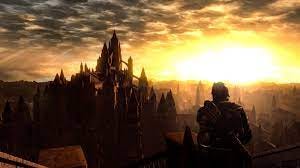
Another interesting feature that was deliberately added was the verticality of the map. In certain acts of the game, you progress higher and higher up as you defeat enemies. This is to give the player a sense of overcoming insurmountable odds. In some of the certain acts, you are led deeper and deeper underground and this is used to symbolize the atrocities upon which this seemingly perfect world has been built.
Multiplayer
I know I've built this up too much, but it's finally here! The most non-essential yet enjoyable aspect of Souls. Why is it non-essential, you may ask. Well, Dark Souls doesn't have many features that are common to MMORPGs. This means that Dark Souls is mostly a single-player experience. But, other players can influence your journey for better or for worse. Players can leave clues that either give you an idea of the dangers that lie ahead or leave you scarred forever because of how badly you were trolled.
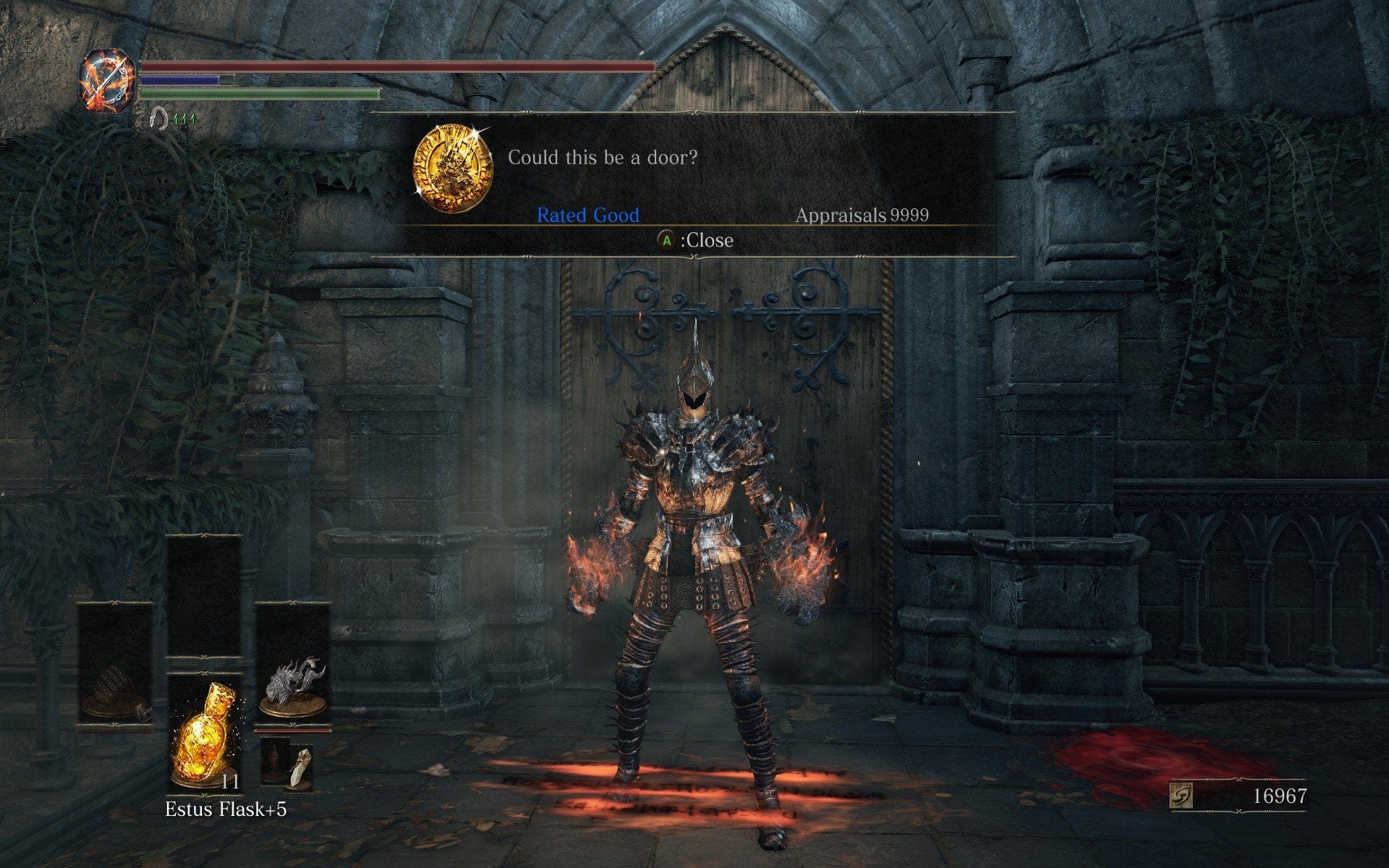
Sometimes, in Dark Souls, you can notice ghosts around you. These ghosts are real-time players who are online on their own instances of the game. But, these ghosts may or may not be able to see you in their instance of the game.
Eventually, in the later parts of the game, you are presented with an item called the Whitesign Soapstone. With this, you can place a summon mark on the floor that acts as an invitation cue to let you join somebody else's game as a friend. If the person who sees this mark is in human form, they can accept the invitation, and you can help each them kill enemies and bosses. But, once the area's boss is slain, you will be removed and will enter back into your world.
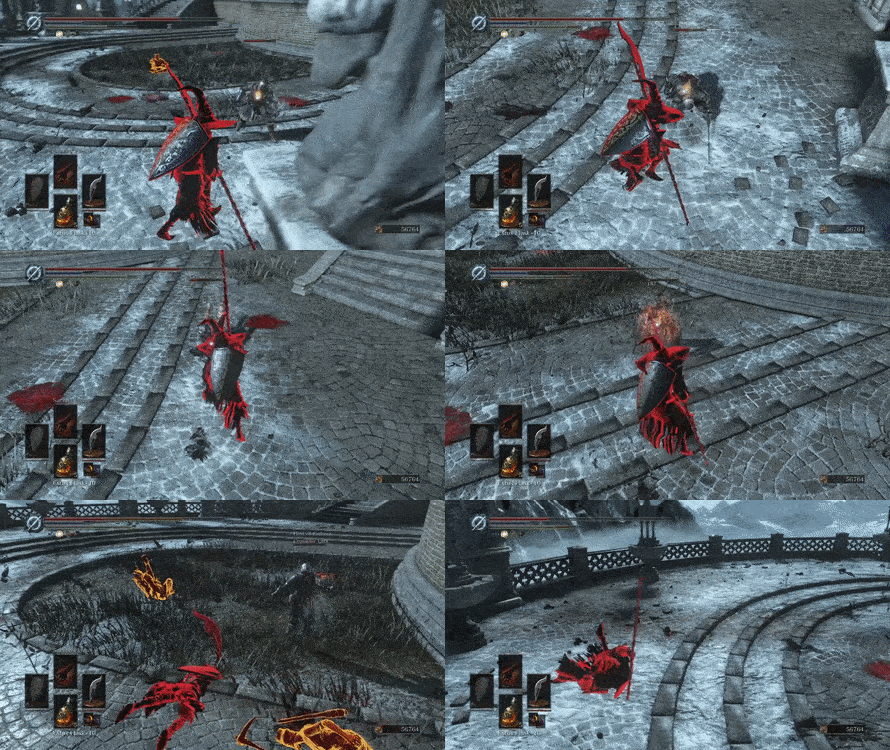
Another way to get into somebody's game is with the Redesign Soapstone. The difference, however, is that this allows you to join other players' worlds as an enemy, i.e. you can duel with each other and the winner stands to gain the souls and humanity of the loser.
Finally, there's the Cracked Eye Orb, which can be used to invade another's game and do whatever the hell you want. Although this is exciting, you have to be careful with this feature, because it is susceptible to hacks.
Our Key Takeaways
We at Infinite Blades aspire to create a Soulslike because we're students of the craft and the thought of creating something that bears semblance to anything remotely created by Hidetaka Miyazaki's team at From Software excites us to no end! This is the ultimate test of our skills as budding game designers.
However, we're a 2 man team, and while Dark Souls is a game that drove a lot of innovation in the Hack-and-Slash RPG genre, it came with its own set of unprecedented flaws such as:
Inability to manage difficulty curves → Because of the non-linear and interconnected world, From Software has never attempted something like this in all of its subsequent releases.
Too many choices → Players are spoilt for choice with the multitude of builds they can create throughout the game. This is a result of the huge number of character stats and weapons that led to overlapping tradeoffs, which you'd ideally like to avoid in a game.
On the other hand, the game has many memorable features that have influenced a lot of our mechanics as well! Here are a few examples:
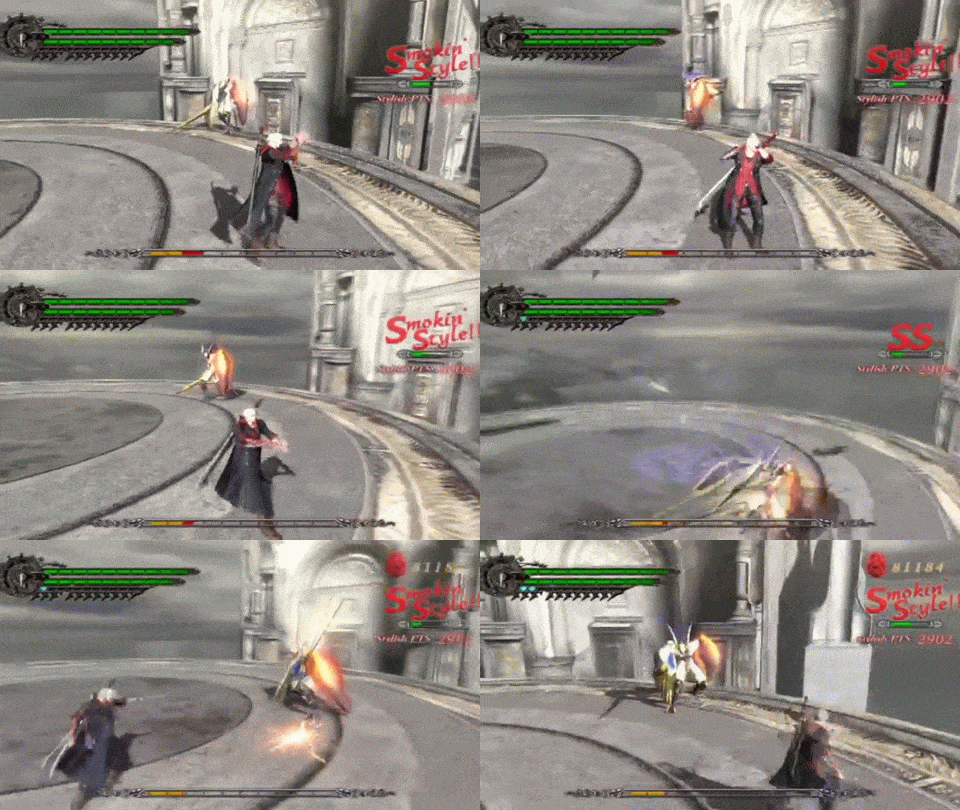
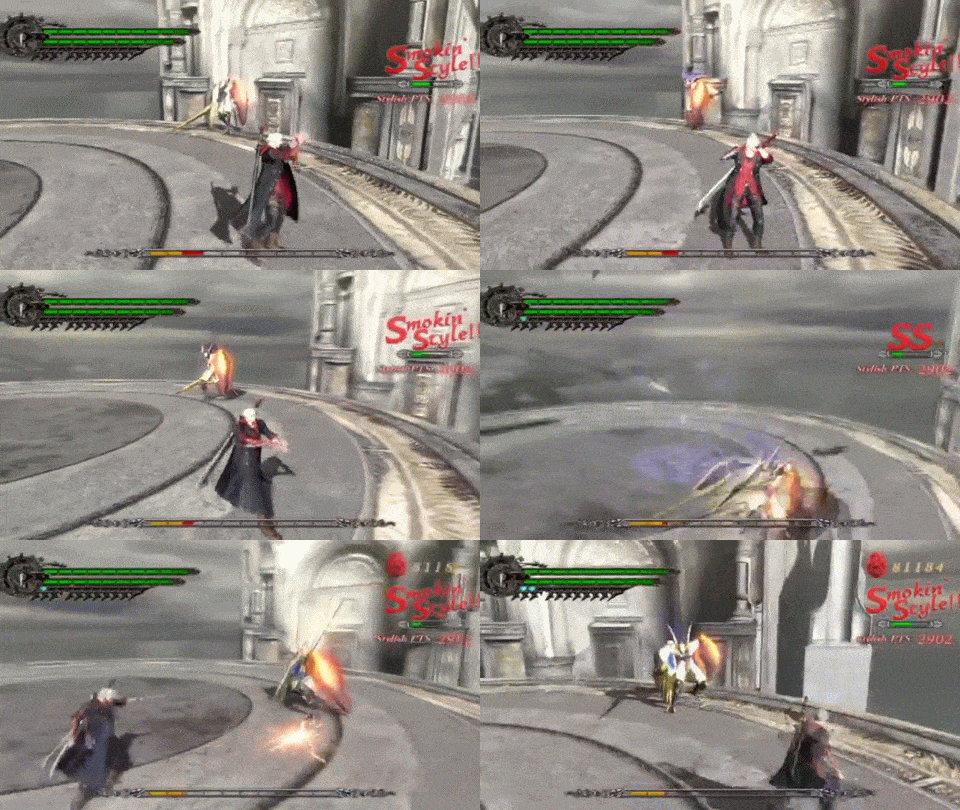
Deliberate and exacting combat system → Careless mistakes are never overlooked and you're forced to pay dearly. This is contrary to most hack-and-slash RPGs, especially ones like Bayonetta and Devil May Cry, where you can seamlessly cancel an attack and transition into a new one. Instead of strategy, the game emphasizes how outlandishly and skillfully you can execute a combo. We resonated with Dark Souls' combat system because we felt that this would make stylistic matchups more interesting by constantly forcing you to think about the tradeoffs of each move you make while also dealing with the consequences.
Ambiguous storytelling → This forces the player to find their own meaning within the game. The environment around you will be used to tell you more about the world you're currently in, and your imagination is the only limiter. This allows you to interpret the world in whichever way you deem fit.
Crafting mechanics → Dark Souls has amazing crafting mechanics with built-in skill trees. As you improve your stats, you gain access to more powerful weapons. But, you also restrict yourself from using weapons meant for other builds since they have a stat requirement that you won't be able to meet. We find this implementation to be very creative.
What This Means for Infinite Blades
Soulsborne games have a plethora of engaging features that work in tandem with one another in order to create wonderful experiences. We think that we can build the next generation of soulslike games by embracing Web3 technologies such as NFTs because of the following reasons:
Complex combat and crafting mechanics → These two features largely form the core loop of the experience. This makes the game hard to get into at first, but once you understand the nuances over time, it puts you in a flow-like state where everything just happens of its own accord.
Value can be created by the player → As you level your character up, the number of unique builds that you can create increases. Most of your leveling decisions are irreversible and this forces you to stick to a combat style that suits your character stats. Most NFT projects are based on profile picture artworks, so their value and rarity are determined by the creators of the project. You might not actually like how the piece looks, but are forced to agree that it is valuable simply because of its rarity. We want to change this by making you in charge of assigning value to the token and determining its rarity. As you excel in the game, the value of your token increases too! If you're gutsy, you can create builds that people are not keen on trying, and you could have the rarest one in the lot!
New ways of monetization → AAA games tend to monetize in ways that are very annoying to the player. One example of this is Assasin's Creed. A lot of features are hidden behind paywalls and while the intentions of the developer are honest, it is demeaning to the player who has already paid for the game itself. We think that the NFT model allows us to sidestep this by no longer acting as a central authority. Features of the game won't be hidden behind paywalls, but the path you take can alter your experience of the game. We intend to allow players to interact and provide value for one another. We'll make our money by taking a minuscule cut of every transaction in exchange for providing a safe way to interact with one another and a cool gaming experience. So, this will drive us to create a game that you will truly enjoy! To get a clearer picture of the potential of blockchain games, here's a link to a video.
Chapter-wise game releases → We've been playing around with the idea of releasing the game in arcs or chapters. This is so that we can deliver the experience to you as quickly as possible and iterate based on the gameplay feedback. We realized that a non-linear world doesn't make sense and that's why we're researching Bloodborne, another From Software game that has mechanics and a world design similar to what we’re gunning for.
Single-player experience instead of an MMORPG → There is a misconception that multiplayer games are more fun because of spontaneity. But, we beg to differ. While multiplayer games are fun, they are difficult to code and require an entire team. But, single-player games flourish because a lot of the programming practices for network code can be ignored, and the team can focus more on re-readability.
Whew, this was a really long piece! We’re really glad that you could stick with us. At the end of the day, this space is still very nascent and since we’re beginners in the world of game design, we feel that we have a unique perspective to offer. We’ve been learning and evolving along with the project, and we’ve had the pleasure to chat with badass founders in the space such as Furqan and Kaspar, who have provided us with many valuable insights. We’re excited to continue building the project while anxiously anticipating what the future holds! So, until next time!